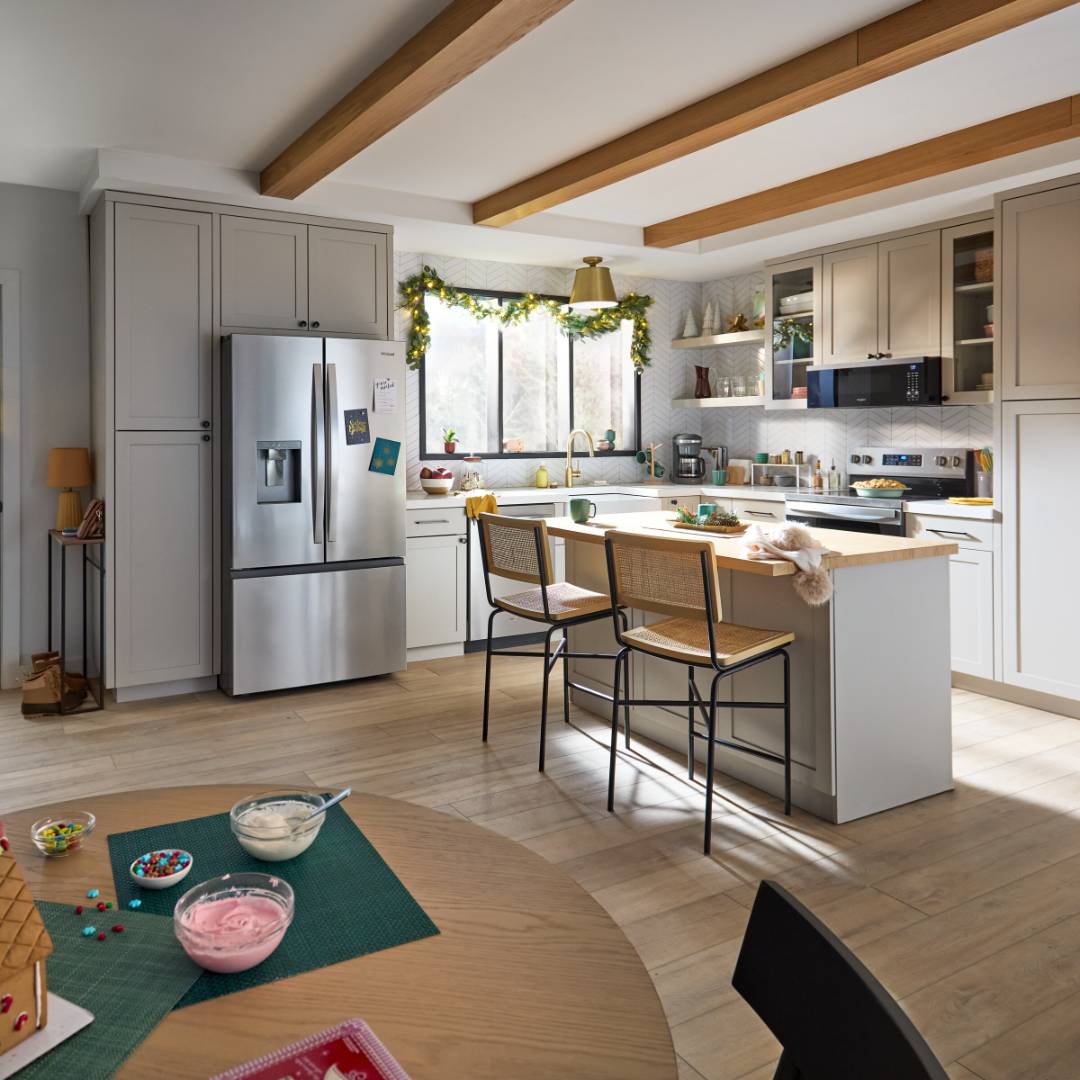

Buying a new refrigerator seems simple enough—pick a style, choose a color, and find one that fits your budget.
But after helping thousands of customers at Mark's Appliance over the years, we've learned that choosing
the right refrigerator has much less to do with the refrigerator itself and much more to do with asking the
right questions beforehand.
In fact, many of the issues we see aren't caused by the appliance at all. They're caused by measurements
that were off by an inch, a doorway that was too narrow, or a water line that should have been replaced
before installation.
Before you buy your next refrigerator, here are the questions we recommend asking yourself.
1. Should I Choose a Counter-Depth or Standard-Depth Refrigerator?
This is the very first question we ask customers when they walk into our showroom.
A standard-depth refrigerator offers the most storage space, but extends farther into the kitchen. Counter-
depth refrigerators are shallower, creating a more built-in appearance while improving walkways and traffic
flow.
Many people automatically assume they want the biggest refrigerator possible, but personally, I don't think bigger is always better.
Today's refrigerators are enormous. Many standard-depth models are approaching 30 cubic feet of storage.
Unless you have a very large family, that extra space often becomes a place where food gets pushed to the
back and forgotten.
A quality counter-depth refrigerator in the 20-22 cubic foot range is more than enough storage for many
households while giving your kitchen a cleaner, more open look.
2. Have I Measured the Opening—or Just My Current Refrigerator?
This is probably the biggest mistake we see. Customers often measure the refrigerator they're replacing instead of measuring the cabinet opening.
Those are two very different things.
We've seen countless situations where someone thought they had enough room, only to discover that:
- Countertop overhang reduced the opening width.
- Floor trim narrowed the space.
- Cabinet dimensions were smaller than expected.
- The existing refrigerator was actually smaller than the opening.
The opening determines the maximum size refrigerator you can install—not the refrigerator that's already
there.
If you're unsure about your measurements, many independent appliance dealers (including Mark's
Appliance) offer free site surveys. We routinely catch measurement mistakes before they turn into
expensive exchanges or delayed installations.
3. Will the Refrigerator Actually Make It Into My House?
This is something many people never think about until delivery day.
Yes, refrigerator doors and the doors to your home can easily be removed to create extra space.
But that doesn't guarantee the refrigerator will fit through your home.
If your home has doorways around 30 inches wide or less, a full-depth, full-size refrigerator may not fit—even with
the doors removed.
Instead of looking at the overall refrigerator depth, look at the case depth listed in the specifications. That's
the measurement installers use when determining whether a refrigerator can make it through your entry
door, hallway, or tight turn.
4. Is There a Wall Next to the Refrigerator?
This simple question can save a lot of frustration. If your refrigerator sits directly against a wall, the doors may not be able to open fully.
That can prevent drawers or crisper bins from sliding out properly and make everyday use more difficult.
Before purchasing, make sure you understand the door clearance requirements for the model you're
considering. You can also look at zero clearance hinge models if you have a situation where the fridge is close up against a wall.
5. How Much Refrigerator Do I Actually Need?
More storage isn't automatically better.
Ask yourself:
- How many people live in your home?
- Do you buy groceries weekly or monthly?
- Do you entertain often?
- Are you constantly running out of room—or do items disappear in the back of your refrigerator?
Buying the largest refrigerator available isn't always the smartest decision.
Choose the refrigerator that matches your lifestyle rather than the one with the biggest number on the
specification sheet.
6. Do I Want an External or Internal Water Dispenser?
This usually comes down to preference, but there are trade-offs.
External Water Dispenser
Pros
- Convenient
- Easy access
- Great for families that use a lot of water
Cons
- Takes up valuable door storage
- Generally includes more moving parts and electronics
Internal Water Dispenser
Pros
- Cleaner appearance
- More usable storage in the refrigerator door
- In our experience, tends to have fewer service issues over time
If your household constantly fills water bottles, an external dispenser may be worth it. If not, don't overlook internal dispenser models—they often provide a better balance of storage and
simplicity.
7. Is My Existing Water Line Ready for a New Refrigerator?
This is something many homeowners never consider.
If your current refrigerator uses an older plastic water line—especially one that's been installed for many
years—it's often worth replacing it when the new refrigerator is installed.
A new refrigerator deserves a reliable water supply, and replacing an aging water line now can help avoid
leaks or future service calls.
8. Which Refrigerator Style Fits My Needs?
Every style has its strengths.
French Door
This is the style I recommend most often.
French-door refrigerators offer excellent organization, wide shelving, and have become the preferred
choice for most homeowners.
Side-by-Side
Side-by-side refrigerators are often more budget-friendly and work well for people who prefer keeping both
fresh and frozen food at eye level.
Some customers simply love this layout, and that's perfectly fine.
Luxury Refrigerators
If you're designing a high-end kitchen, brands like Sub-Zero remain the benchmark.
JennAir, Thermador, and Monogram also produce outstanding luxury refrigeration.
For homeowners looking for a premium freestanding refrigerator, Café and Bosch are excellent choices.
Bosch's 800 Series models, in particular, feature dual compressors, which help maintain more consistent
temperatures by separating the refrigerator and freezer cooling systems.
9. What's the Most Reliable Refrigerator Brand?
This is probably the question we're asked more than any other.
The honest answer? There isn't one perfect brand.
Over the years, we've seen problems—and great experiences—with virtually every manufacturer.
Instead of asking:
"What's the most reliable refrigerator?"
I'd encourage customers to ask:
"Who will service my refrigerator if something goes wrong?"
That's often more important than the logo on the door.
Buying from a local appliance retailer with an in-house service department gives you someone to call if you
ever need help. You're not relying solely on an 800-number customer service line or waiting for the
manufacturer to coordinate repairs.
That's one of the biggest advantages independent appliance dealers provide.
Generally speaking, manufacturers with a significant U.S. presence—such as Whirlpool, GE, and Bosch—
also tend to have good parts availability, which can make repairs faster when they are needed.
10. Should I Bring Anything With Me Before Shopping?
Absolutely.
The two most helpful things you can bring are:
- The model number of your current refrigerator
- Measurements of the cabinet opening
Having your existing model number allows us to instantly compare dimensions, capacity, and installation
requirements.
Having the opening measurements allows us to determine exactly what will fit—without guessing.
Those two pieces of information can save hours of frustration and prevent expensive delivery surprises.
A Real Example From One of Our Site Surveys
One project that stands out involved a new construction home installing two 18-inch refrigerator columns.
During our site survey, we discovered the electrical outlet and water shut-off valve had been installed in the
wrong location compared to the manufacturer's specifications.
Fortunately, the home hadn't been drywalled yet, so the builder was able to relocate everything before
installation.
Had we not caught it early, it could have resulted in significant delays and additional construction costs.
That's why we believe site surveys are about much more than measurements—they're about preventing
problems before they happen.
Final Thoughts
If there's one piece of advice I'd leave you with, it's this:
Bigger isn't always better.
The best refrigerator isn't necessarily the largest one or the one with the most features.
It's the one that fits your kitchen, fits your family's lifestyle, and can be properly installed without surprises.
Measure your opening—not just your current refrigerator.
Check your delivery path.
Think about how you'll actually use the refrigerator every day.
And if you're unsure, don't guess. Bring your current model number or schedule a site survey before you
buy.
A little planning upfront can save a lot of headaches on delivery day.